




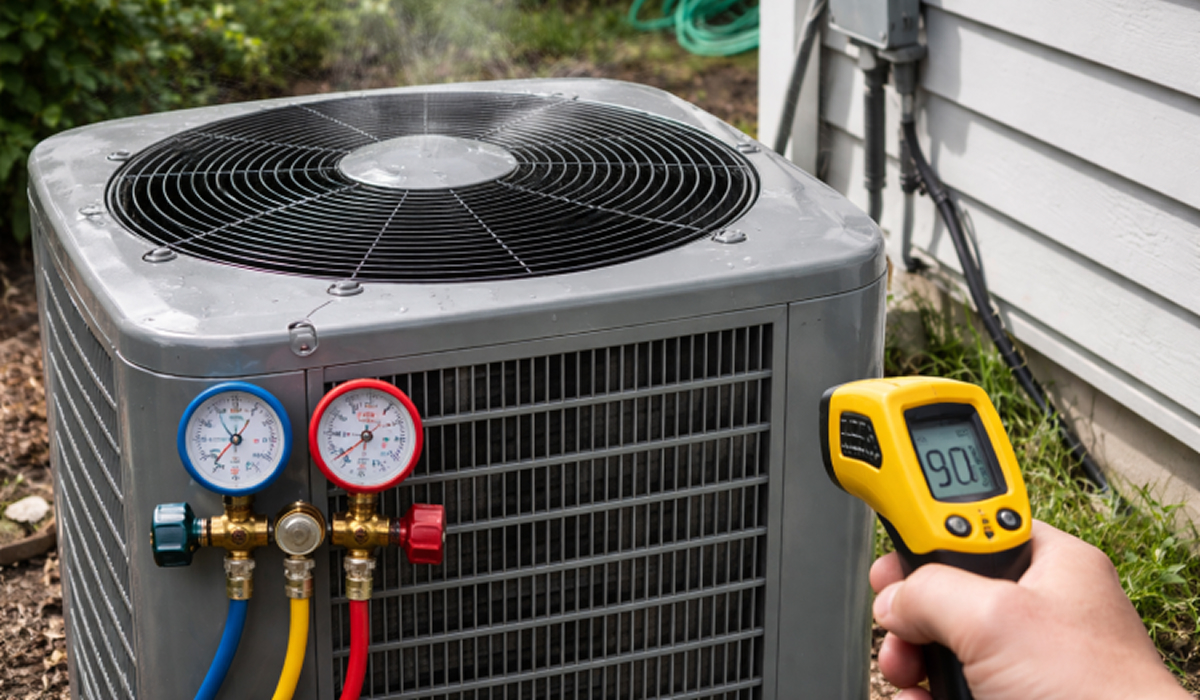


Nobody wants to think about their air conditioner in April. But here's the thing — the homeowners who do think about it in April are the ones sleeping comfortably in July. The ones who wait until that first 90° day? They're the ones calling every HVAC company in town hoping somebody can squeeze them in before the weekend.
If your AC has been acting up, or you're just wondering whether it's got another summer in it, here are the signs worth paying attention to.
1. Warm Air From the Vents
This is the big one. When it's 85° inside, you've got the thermostat set to 72°, and the vents are pushing air that feels roughly the same temperature as the air in the room — something is wrong.
Sometimes it's a simple fix (bad capacitor, tripped breaker, dirty filter). But if you've already had a tech out once or twice and it keeps happening, you're looking at a deeper issue — usually a refrigerant leak or a failing compressor. Neither is cheap to chase on an older unit.
2. It Runs and Runs Before It Actually Cools
A healthy AC should cycle on, pull the temperature down, and shut off. If yours is running 45 minutes at a stretch and barely making a dent — or worse, running nonstop — that's a symptom, not the disease.
The disease is usually a slow refrigerant leak. And here's the uncomfortable truth: 9 out of 10 air conditioners over 10 years old have one. Some are small enough that you can top off the refrigerant and limp along for another season. But if your system uses R-22 (the old "Freon" that was phased out in 2020), topping it off can run $100+ per pound — and a typical system holds 5 to 10 pounds. At that point, you're just renting time.
3. Water Pooling Near the Indoor Unit
Walk over to your furnace/air handler. See any rust? Any staining on the floor around it? Water?
Your AC produces condensation when it runs — that water is supposed to drain out through a small PVC line. But on older systems, the drain pan under the evaporator coil rusts out, and water starts leaking into or around the furnace. By the time you see it on the floor, it's been dripping onto metal components for a while.
Replacing just the coil on an older system is rarely worth it. You're usually into thousands of dollars on a unit that's already on borrowed time.
4. Grinding, Banging, or Humming You Can Hear From Inside
A properly running AC — even an older one — should be quieter than a normal conversation when you're standing next to the outdoor unit. If yours sounds like a lawnmower, a washing machine with an unbalanced load, or a jet engine, something is wearing out.
Common culprits: failing fan motor, worn-out compressor bearings, or loose components vibrating themselves apart. These aren't "it'll fix itself" problems. They get louder and more expensive the longer you ignore them.
5. The Repair Bills Are Stacking Up
This is where the math gets honest. A new compressor: $1,000–$2,000 installed. A new evaporator coil: often $2,000–$3,000+. Blower motor, condenser fan motor, control board — each one is a few hundred to over a thousand.
Rule of thumb: if a single repair costs more than half of what a new system would cost, replace it. And if you've already dumped $1,500 into the unit over the last two summers, the next repair is almost always the one that tips the scale.
6. Your Energy Bills Keep Climbing
Pull out last July's electric bill. Now compare it to July five years ago. If your usage patterns haven't changed but your bill has quietly crept up 20-30%, your AC is working harder to produce the same amount of cooling.
Modern systems are dramatically more efficient than anything built before 2015. A 14 SEER unit replacing a 10 SEER unit — which is where a lot of older Minnesota homes sit — can cut cooling costs by 25-30%. That efficiency gap is real money every month the system runs.
7. The Unit Is Over 15 Years Old
A well-maintained central AC lasts 12 to 15 years in our climate. Some push 18 or 20 if they've been babied. But once you're past that 15-year mark, every component is on the back half of its life, refrigerant rules have changed, efficiency standards have jumped, and replacement parts are getting harder to find.
You don't have to replace it the day it turns 15. But you should be budgeting for it — and you shouldn't be surprised when it goes.
What a New System Actually Costs (And How to Make It Manageable)
This is the part most people don't know until they ask: new AC installs don't have to be a $10,000 hit to the wallet.
At Mitlyng, new AC installs start at $5,299 with a 10-year warranty. We also offer 0% financing for up to 60 months with $0 down — which turns a system upgrade into a manageable monthly payment instead of a budget emergency. And depending on what you install, you may qualify for $2,000+ in utility rebates from Xcel or your local co-op.
The free in-home estimate is exactly that — free. No pressure, no upsell, just a real quote with real numbers.
Don't Wait for the First 90° Day
Every year it's the same story: the first real heat wave hits, every AC that was "probably fine" suddenly isn't, and HVAC calendars across the region fill up in 48 hours. Planning ahead is cheaper, calmer, and you get to pick the install date that works for you.
If any of the signs above sound familiar, it's worth a conversation.
Get your free in-home AC estimate →
Or call us directly at 320-269-2970 — Lisa will get you on the schedule.


